


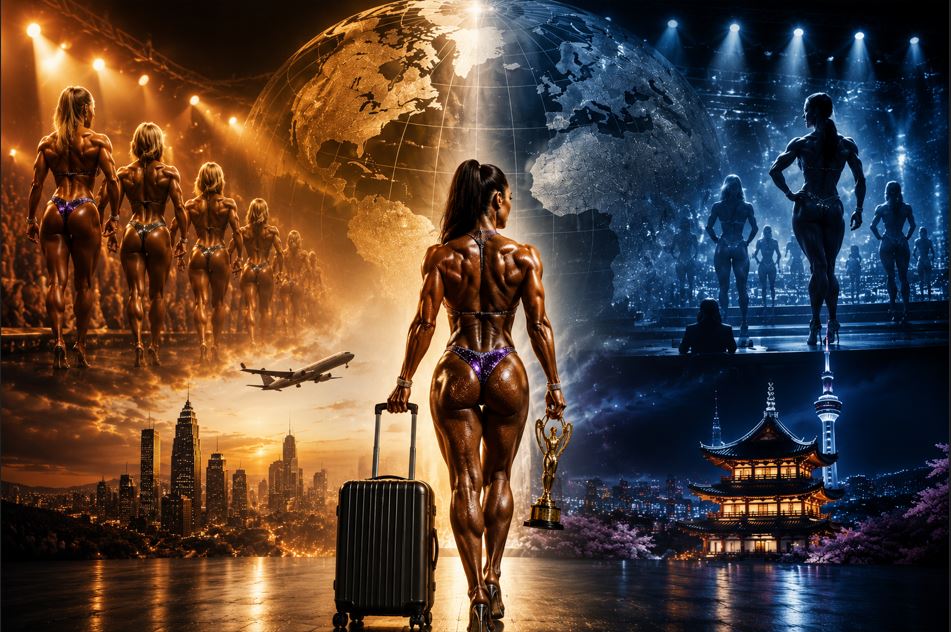
Athletes are strategically chasing points and qualifications in weaker competitions
In professional bodybuilding, reaching the Mr. Olympia is the ultimate dream. Competing on the biggest stage in the world represents prestige, financial growth, international recognition, and often a complete career transformation.
But behind the scenes of the professional circuit, one discussion has been growing rapidly:
Some athletes are strategically choosing “weaker” competitions to pursue Olympia qualification points and titles.
And this is not conspiracy theory.
It is competitive strategy.
The calendar changed the game
Over the past few years, the number of professional bodybuilding shows has exploded.
Today, events are held across:
- the United States,
- Brazil,
- Europe,
- Asia,
- the Middle East,
- and Latin America.
As a result, one inevitable reality emerged:
Not all competitions have the same level of difficulty.
Some lineups look almost like a mini-Olympia.
Others feature:
- fewer athletes,
- lower overall conditioning,
- absence of elite names,
- and less competitive depth.
Athletes noticed this very quickly.
The smart strategy behind the circuit
Many competitors no longer focus only on the biggest shows of the season.
Today, athletes and coaches carefully study:
- the calendar,
- the level of registered athletes,
- the competition history,
- logistics,
- travel fatigue,
- proximity to the Olympia,
- and the presence — or absence — of dominant names.
In other words:
It’s not enough to be good.
You must choose the right battle.
The Camile Luz case: a perfect strategy?
One highly discussed example involved Brazilian athlete Camile Luz.
Even though she had already qualified for the 2025 Olympia, Camile and her coach Ricardo Pannain decided to compete in South Korea one week before the Olympia.
The strategy immediately attracted attention.
Camile’s physique was visibly superior to many of the local competitors in that lineup. In addition, because she was already at the peak of her Olympia prep, she barely needed to make any physical adjustments before stepping on stage.
In other words:
- she was already ready,
- entered a more accessible lineup,
- won the show,
- and secured her qualification for the following Olympia season.
It was an extremely strategic move.
And more than that:
highly efficient.
In modern bodybuilding, timing, scheduling, and competitive intelligence can be just as important as the physique itself.
Many people in the industry viewed Camile Luz and Ricardo Pannain’s decision as a perfect example of smart professional circuit management.
The Asian risk: the Vietnam situation
But strategies do not always work perfectly.
In Vietnam, for example, Brazilian athletes ended up losing to a local competitor who genuinely brought a competitive physique — although the result generated controversy behind the scenes and across social media.
Many believed the Brazilian athletes had done enough to win.
Others defended the local champion.
And this opens another important discussion within international bodybuilding:
The “home country” factor.
There is a growing perception among athletes and coaches that some competitions may slightly favor local athletes when the physical differences are not overwhelmingly obvious.
That does not necessarily mean unfair judging.
But in close contests:
- judging interpretation,
- stage presence,
- audience reaction,
- and even local commercial interests
can influence final decisions.
Especially in regions where bodybuilding is rapidly expanding.
The financial investment is massive
Another important factor that fans rarely see behind the scenes:
competing overseas is extremely expensive.
When athletes decide to compete in Asia or distant countries, the financial investment increases dramatically.
Expenses include:
- international flights,
- hotels,
- specialized nutrition,
- supplements,
- transportation,
- federation fees,
- local travel,
- coaching,
- hair and makeup,
- tanning,
- translators in some situations,
- and the physical stress of long flights.
In other words:
sometimes chasing a technically “easier” competition actually requires much greater financial sacrifice.
Not every athlete can afford that.
Which means the current system often favors competitors who have:
- stronger sponsorships,
- better financial structure,
- or internationally organized teams.
What coaches have realized
Today, many coaches study the competition calendar strategically.
It is no longer just about building a great physique.
It is about:
- selecting the right show,
- understanding judging tendencies,
- evaluating the lineup,
- analyzing the category moment,
- and maximizing victory probability.
Coach Robert recently drew attention for exactly this type of strategic thinking.
While many coaches focus heavily on U.S.-based competitions, Robert decided to send his athletes Sarah Malta and Carol Cardoso to South Korea in pursuit of points and Olympia qualification.
The move generated major discussion online and intensified the debate about competitive intelligence in modern bodybuilding.
In a social media post, Robert stated:
“I prefer a positive result over a clear anticipated defeat. Every coach chooses what’s best for their athletes, and I think about what’s best for mine — not about marketing satisfaction.”
That statement perfectly summarizes the current mentality within the professional circuit.
The logic is simple:
there is little value in entering the toughest shows in the world if it drastically reduces your real chances of qualification.
Social media changed everything
Today, athletes do not compete only on stage.
They compete:
- on Instagram,
- on YouTube,
- in viral clips,
- behind the scenes,
- through hype,
- and through personal branding.
And there is one undeniable truth:
“Olympia qualified” has enormous commercial value.
Far more than:
- “finished 7th in an extremely stacked lineup.”
Because of that, many athletes prefer to:
- win smaller shows,
- build authority,
- generate headlines,
- attract sponsors,
- and increase market value.
Even knowing they may still be below the absolute elite of their division.
The Olympia still separates the true elite
At the end of the day, the Olympia still does one thing extremely well:
separating qualified athletes from real title contenders.
Because one thing is:
- winning a smaller Pro Show.
A completely different reality is:
- standing next to the best physiques on the planet.
And that is where:
- the real level becomes clear,
- the differences become undeniable,
- and the sport reveals who truly belongs among the world’s elite.
Modern bodybuilding became a complete game
Today’s professional athlete must master:
- physique,
- strategy,
- marketing,
- logistics,
- scheduling,
- recovery,
- media,
- positioning,
- and competitive intelligence.
The Olympia remains the ultimate dream.
But the path to get there has never been more strategic.

